
Gardena Wood Flooring handles hardwood floor repair in Gardena, CA, serving surrounding cities including Alondra Park, West Athens, West Rancho Dominguez, Lawndale and Hawthorne. For more than 20 years we have worked on floors that families have lived on for decades, and our first answer is almost always a repair or refinish rather than a replacement.
Most damaged hardwood can be put right. A gouged board can be cut out and replaced, a squeak can be fastened from the right place, and a soft spot can be opened and rebuilt. What makes a repair last is finding what caused the damage, because a board replaced over a leak or a loose joist will fail the same way again.
This page walks through the repairs we make most often, the noises and movement that point to something underneath, the damage that has a cause below the floor, and how we blend a repair into an older floor so it stops looking like a patch.
Repairs We Make Most Often
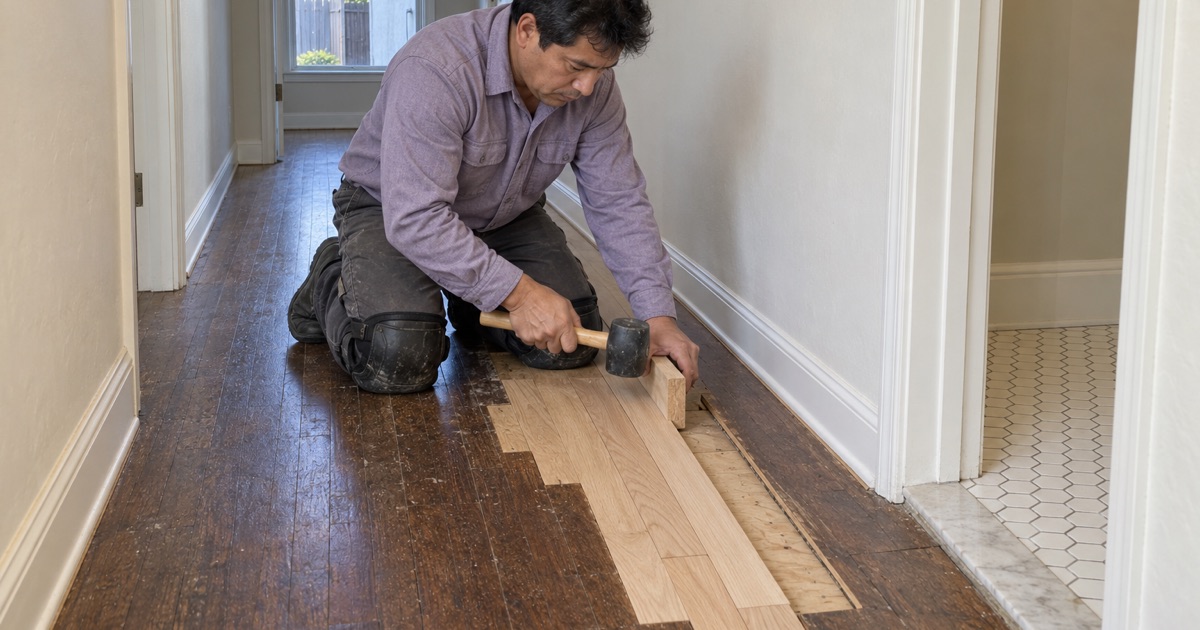
Board Replacement With a Weave-In Repair
When a board is split, gouged, burned or stained through, we remove it and weave in a new one. A weave-in repair staggers the replacement boards so their ends fall in different places, following the pattern of the original floor instead of leaving a straight seam across it.
The replacement boards are fitted with their tongues and grooves trimmed as needed, glued and fastened, then sanded flush with the surrounding floor. Done this way, the repaired area reads as part of the floor rather than a square someone cut out.
Deep Scratches, Dents and Gouges
Scratches that stay in the finish can be screened and recoated. Scratches that cut into the wood, dents from dropped objects and gouges from moving furniture need either spot sanding or board replacement depending on depth and how many boards are affected.
The Janka hardness rating of the species tells you how easily the floor dents in the first place. Red oak and white oak sit in the middle of the range, while softer species like walnut or pine show dents from ordinary use, which is worth knowing before choosing replacement boards.
Pet Urine and Deep Stains
Pet urine stains start as a light mark in the finish and, once they reach the wood, turn gray, then dark brown or black. At that point the stain runs deep in the fibers, and sanding far enough to reach it would thin the board too much.
We replace those boards rather than bleaching or chasing the stain, then check the subfloor underneath for odor and damage before the new wood goes in. On a large area, we may recommend sealing the subfloor before replacement.
Gaps Between Boards
Small seasonal board gaps are normal and close again when humidity returns. Wider gaps that stay open can be filled with wood slivers glued into the seams on older floors, which moves with the wood better than putty.
If gaps are widening or appear alongside cupping, we measure moisture content in the boards and the subfloor before filling anything. Filling a floor that is still drying or still wet only moves the problem somewhere else.
Noise, Movement and Soft Spots
Squeaks and Creaks
Most squeaks come from boards rubbing against their nails, or from a gap between the subfloor and a floor joist below. On a house with a raised foundation we can often reach the framing from the crawl area and fix the gap from underneath, which leaves the finish floor untouched.
Where the underside is not reachable, we fasten the board from above with trim screws or face nailing set below the surface and filled to match. The goal is a quiet floor without a line of visible repair heads.
Nail Pops and Loose Boards
Nail pops happen when a fastener backs out of the subfloor and lifts above the surface, catching socks and mop heads. Loose boards rock or click underfoot, usually because the fasteners holding them have lost their grip.
We reset or replace the fasteners, add glue where the board has worked loose, and fill and touch up the finish. If many boards across a room are loose, that points to a subfloor or moisture problem worth checking before refastening everything.
Soft Spots Over Failed Decking
A floor that gives underfoot usually means the floor decking beneath has softened, often a particleboard subfloor that swelled after a leak or plywood that has delaminated. Occasionally it is a cracked joist or one that was notched too deeply for plumbing.
We remove the finish boards over the area, cut out the failed decking, and sister new lumber alongside any damaged joist. Once the base is solid again, the original boards or matching replacements go back down and are blended in.
Buckled or Lifted Boards
Buckling is boards pushing up off the subfloor, usually because the floor took on water or has no expansion gap at the walls to move into. It rarely fixes itself as the floor dries.
We find the cause first, then relieve the edges or replace the lifted boards. If the floor was installed tight to the walls, we trim back enough to create a proper expansion gap under the baseboard and shoe molding.
Damage With a Cause Underneath
Termite and Powderpost Beetle Damage
Small round holes, fine powder, or pellet-shaped termite frass near the floor edge can mean drywood termites, subterranean termites or powderpost beetles. Each needs a different treatment, and that treatment should be done by a pest control company before the floor is repaired.
Once the infestation is dealt with, we cut out the damaged boards and check the decking and joists beneath for hidden damage. Boards that look fine on top can be hollow underneath, so we probe the area before deciding how far the repair goes.
Water From Appliances, Pipes and Slabs
Most water damage we repair traces back to a dishwasher supply line, a refrigerator icemaker line, a water heater, or a slab leak under the floor. The wood near the source darkens, cups and loosens first.
We find and confirm the source before repairing, take moisture readings across the area and photograph the damage. Those records help if an insurance claim is involved, and they tell us how much of the floor and subfloor actually has to come out.
Cupping and Crowning
Cupping, where board edges sit higher than the centers, means the underside of the floor is wetter than the top. Crowning, the reverse, often follows when a cupped floor was sanded flat before it dried out.
The repair is to remove the moisture source and let the floor dry to stable readings, which we confirm with a meter over several visits. Only then do we decide whether the boards can be sanded flat or need replacing.
Blending a Repair Into an Older Floor
Matching Species, Width and Grade
Most older floors here are strip oak, and red oak and white oak look different once finished, so we identify the species before sourcing boards. Width, grade and the direction of the grain all affect whether a repair disappears or shows.
Where possible, we borrow boards from a closet or under built-in cabinets for the most visible repair spots and put new stock in the hidden area instead. Old wood has already aged to the room’s color, which makes the blend easier.
Spot Finishing or Refinishing the Room
A small repair can often be sanded and finished on its own and feathered into the surrounding finish. On floors where the finish has aged or ambered heavily, a spot repair may stay visible, and refinishing the whole room is the only way to make it disappear.
We tell you which to expect before the work starts, so you can decide whether a patch that is close enough is acceptable or whether the room should be refinished as part of the same visit.
- 20+ Years in Business
- Written Moisture Readings
- Lead-Safe Work Practices