
Gardena Wood Flooring builds and refinishes hardwood stairs in Gardena, CA, serving surrounding cities including Alondra Park, West Athens, West Rancho Dominguez, Lawndale and Hawthorne. After 20+ years of floor work, we treat stairs as their own job rather than an add-on, because every step is measured, cut, fitted and finished one at a time.
That is also why we price stairs per tread and riser rather than folding them into a square-foot number. A quote built that way shows you what each part of the staircase costs, and it does not hide the handwork a staircase takes behind a floor rate.
This page covers replacing carpeted stairs with hardwood, refinishing existing wood stairs, the parts of a staircase and the choices for each, and how we match the stairs to the floors around them.
Replacing Carpeted Stairs With Hardwood
What Is Under the Carpet
Many staircases were built to be carpeted. Under the carpet, pad and tack strip you often find rough construction treads with no finished stair nosing, gaps at the skirt boards and risers that were never meant to be seen. Other houses have finished hardwood treads that were covered up years ago.
We lift a corner during the estimate to see which you have. It changes the job from a refinish to a full tread replacement, and the price with it.
Fitting New Treads and Risers
On rough stairs, we remove the old treads or cut back the nosing, then fit new hardwood stair treads and stair risers to each step. Older staircases are rarely square, so every tread is scribed to the walls and skirt boards individually rather than cut to one standard length.
Treads are glued and fastened to the stringers, and we check each step for movement before fastening. A tread fitted over a loose stringer will squeak no matter how well it is cut.
Nosing, Landings and Transitions
The stair nosing is the rounded front edge of each tread and the most worn part of any staircase. Where the stairs meet a landing or the floor above, we fit a matching landing tread or flush nosing so the floor and staircase read as one surface. At the bottom, the transition to the floor below is planned before installation, so the first riser height stays consistent with the rest and nobody catches a toe.
Squeaky and Loose Steps
A squeak on a staircase usually means a tread is moving against its riser or a stringer, often because glue blocks underneath have dried out or fasteners have loosened. Covering it with new hardwood without fixing it just moves the noise up a layer.
Where the underside of the stairs is reachable, from a closet or open basement area, we add glue blocks and fasteners from below. Where it is not, we fasten each tread from above before the new wood goes on, and set the fasteners where the nosing or a filled hole will hide them.
Refinishing Existing Wood Stairs
Sanding by Hand
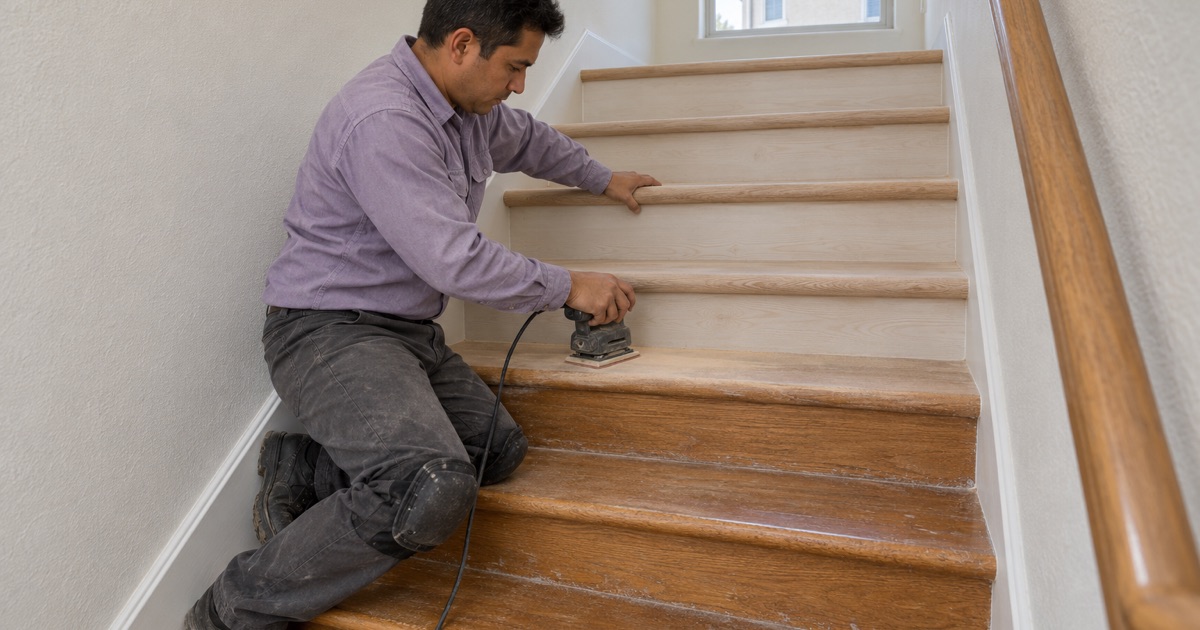
Stairs cannot be sanded with the large drum sander used on floors. Treads are sanded with an edger and orbital sander where they fit, and the corners, nosings and risers are finished largely by hand.
That handwork is what takes the time. It is also where a careless job shows, with sander marks on the nosing or finish pooled in the corners, so we give it the same attention as the floor.
Risers, Railings and Balusters
Risers are often painted rather than stained, which gives a clean contrast with wood treads and is easier to keep clean. Railings and balusters can be refinished with the stairs or left as they are.
On a house built before 1978, painted risers and railings may carry lead paint. We follow lead-safe work practices under the EPA Renovation, Repair and Painting rule when sanding or scraping near painted surfaces, with containment and a thorough cleanup.
Finish and Sheen for Stairs
Stairs take concentrated wear at the nosings and center of each tread, so they need a durable finish. We use waterborne or oil-modified polyurethane at or under the 275 g/L limit set by SCAQMD Rule 1113, and recommend a satin or matte sheen rather than gloss because gloss on stairs can be slippery and shows every scuff.
For households with small children, older relatives or dogs, a runner or individual stair treads with a grip backing can be added over the finished wood. They protect the most worn part of each step and can be replaced far more cheaply than sanding the staircase again.
Choosing Materials
Species and Hardness
Stairs take more wear than any floor in the house, so hardness counts. White oak and red oak are the most common stair species and hold up well; hickory and maple are harder still. Walnut looks striking but dents more easily on a busy staircase. Matching the stair species to the floor usually looks best, especially where the staircase is visible from the main rooms.
Solid Treads Over Engineered Floors
Even when the floor is engineered hardwood, stair treads are usually solid wood, because the nosing is rounded and sanded in a way a thin wear layer cannot take. Many engineered product lines offer matching solid treads and nosing, which we source with the floor.
Where a matching tread is not available, we use solid treads in the same species and match the color with stain during finishing. The treads then wear and refinish like any solid wood step, which is what a staircase needs over the long run.
Keeping the Staircase Usable
In a house with only one staircase, we often work alternate steps, finishing every other tread so the stairs can still be used carefully. You get a written cure schedule that shows when each step can take normal traffic again.
When the stairs are part of a larger floor job, we schedule them last, after the rooms above and below are finished. That way nobody carries tools or furniture over freshly finished treads, and the nosings do not take the first scuffs of the project.
- 20+ Years in Business
- Written Moisture Readings
- Lead-Safe Work Practices